
The silence in our house didn’t start the day Daniel left. It started three years earlier, the night Maya came home shaking, her eyes wide with a terrifying, absolute certainty.
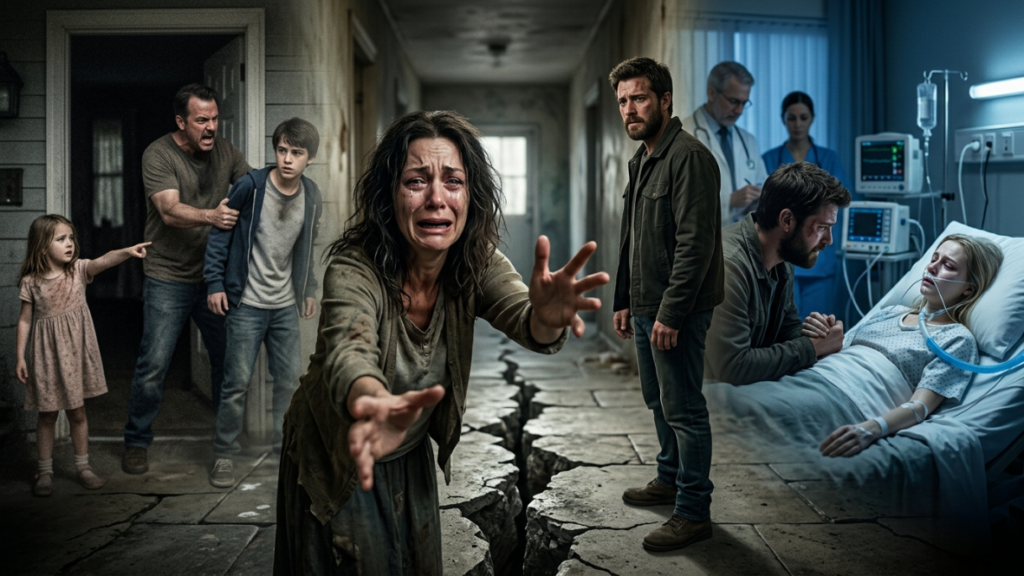
She was seventeen. Daniel was twenty.
“He touched me,” she whispered to my wife, Sarah, and me in the living room. Her voice was barely audible, but the words hit like a wrecking ball. “Daniel. Last night, when you were both asleep.”
I remember the instant, sickening drop in my stomach. As a father, your instincts split in two—one half wants to tear the world apart to protect your daughter, and the other half refuses to believe your own son could carry darkness like that.
When we confronted Daniel, his reaction wasn’t guilt or panic—it was utter, bewildered horror. “Are you out of your mind?!” he shouted, his voice cracking. “Dad, Mum, I swear on my life! I was in my room all night! I didn’t even go near her!”
But Maya’s tearful conviction was undeniable. Sarah believed her instantly. The rift was immediate, devastating, and absolute. Within twenty-four hours, Sarah told Daniel he couldn’t stay in the house.
“If you don’t believe me, then I don’t have a family,” Daniel said, his eyes cold with a pain that haunted me every night after. He packed one duffel bag, walked out the front door, and cut all ties. He changed his number. He moved cities. For six years, my son was a ghost.
Our family became a shell of itself. Sarah and I stayed together, but the joy was sucked out of the house. Maya became distant, wrapped in a dark, protective cocoon. We treated her with velvet gloves, terrified of triggering her trauma.
Then came the second tragedy.
At twenty-three, Maya was diagnosed with a rare, aggressive form of cancer. Within months, treatments failed. The doctors told us to prepare for the end.
Watching my daughter fade away was a different kind of agony. Sarah never stopped trying to contact Daniel, sending letter after letter to his last known address, leaving voicemail messages on old numbers, begging him to come home before it was too late. There was never an answer.
On a rainy Tuesday night in the hospice room, Maya requested to be alone with me. Sarah went down to the cafeteria, leaving us in the quiet hum of the heart monitors.
Maya’s hand felt paper-thin in mine. Her eyes, sunken and pale, stared up at the ceiling.
“Dad,” she whispered.
“I’m here, sweetheart.”
“I need to tell you… I need to clean it all out. Before.” A tear leaked from the corner of her eye, slipping down into her temple.
“You don’t have to say anything, Maya. Just rest.”
“No,” she insisted, her grip feebly tightening on my fingers. “I have to. Dad… I lied.”
The room seemed to freeze. The steady beat of the monitor felt like an iron hammer on my chest. “What do you mean?”
“About Daniel,” she choked out, sobbing softly. “I lied. He never touched me.”
I couldn’t breathe. “Maya… why? Why would you say that?”
“I was failing school… I had a secret boyfriend you hated, and he was pressuring me… Daniel found out. He was going to tell you guys that night,” she wept, her chest heaving. “I panicked. I thought… if I made you hate him, you wouldn’t believe anything he said about me. I thought I could just say it once and take it back later, but… but everyone freaked out. And then he left. And I was too terrified to tell the truth.”
The room spun. Six years. Six years of losing my son, of a broken home, of glaring at Daniel’s framed picture in the hallway with silent resentment. My daughter had destroyed our family out of a teenager’s panicked cowardice, and the lie had swallowed us whole.
I felt a surge of rage so hot it terrified me—followed immediately by a crushing, agonizing grief. Look at her. She was dying. What was I supposed to do with this truth?
“Please,” Maya sobbed, looking at me with terrified, desperate eyes. “Please find him, Dad. Tell him I’m sorry. Don’t let him hate himself.”
Three days later, Maya passed away.
The funeral was small. Sarah was destroyed, weeping over our daughter’s casket. I stood beside her, carrying a weight so heavy it felt like it was breaking my spine. I hadn’t told Sarah yet. I couldn’t ruin the few moments she had left to grieve her daughter without taint.
As the service ended and people began to trickle away under the gray drizzle, I stayed behind near the grave.
That’s when I saw him.
Standing fifty yards away, under the shadow of an oak tree, was a tall man in a black coat. His hands were jammed in his pockets, his shoulders hunched against the cold. Older, broader, but unmistakably Daniel.
He hadn’t come to the service. He had waited until everyone left.
I didn’t say a word to Sarah. I walked away from the gravesite, my shoes squelching in the mud, heading straight toward the tree. As I got closer, Daniel turned to walk away.
“Daniel!” I called out, my voice breaking. “Daniel, please!”
He stopped, but he didn’t turn around.
When I reached him, I saw the guard he had put up—a wall built over six years of exile and undeserved shame.
“I didn’t come to cause trouble,” Daniel said, his voice deep, hollow, and cold. “I just… I wanted to make sure she was actually gone. So I could stop looking over my shoulder.”
“Daniel,” I whispered, tears blurring my vision. “She confessed.”
He went completely still. Slowly, he turned his head to look at me. “What?”
“Before she died… she told me everything. She told me why she did it. She admitted she lied.” I took a step closer, my hands trembling. “You were innocent, Daniel. You were innocent the whole time. And we destroyed you.”
The wall in his eyes didn’t crumble immediately. Instead, a wave of profound, devastating confusion washed over his face. He swallowed hard, staring at me as if waiting for the catch.
“She… she told you?” he rasped.
“Yes. She begged me to find you and tell you she was sorry.” I fell to my knees right there in the wet grass, unable to hold myself up anymore. “I’m so sorry, son. I’m so, so sorry we didn’t believe you. I failed you. Your father failed you.”
For a long, agonizing moment, there was only the sound of the rain hitting the leaves above us.
Then, I felt a hand on my shoulder.
I looked up. Daniel was kneeling in the mud in front of me. Tears were finally breaking through his stoic mask, tracing lines down his face. He didn’t say I forgive you. He didn’t say it’s okay, because it wasn’t.
Instead, he leaned forward and pulled me into a tight, trembling embrace.
“I missed you, Dad,” he sobbed into my jacket.
Our family would never be whole again. The scars of those six years were deep, and the road to rebuilding trust with Sarah and me would take time, therapy, and endless patience. But as I held my son in the rain, feeling the warmth of a bond restored from the ashes of a tragic lie, I knew one thing for certain:
The truth had cost us everything—but it had brought my son back home.
part 2
The walk back to the car from that oak tree was the longest fifty yards of my life.
Daniel walked alongside me, his stride hesitant, every step weighed down by six years of displacement. Sarah was still standing near the lowering rig, staring blankly at the dark earth covering Maya’s casket.
When she turned and saw Daniel, she froze.
For a terrifying second, I saw the old reflex flare in her eyes—the instant, protective rage of a mother who believed this man had destroyed her daughter. She took a sharp breath, her body stiffening. “What is he doing here?” she spat, her voice trembling with grief and anger. “How dare you—”
“Sarah, stop,” I said, my voice quiet but firmer than it had been in years. I walked up to her, placing my hands on her shoulders. “Listen to me. You need to listen to me right now.”
“Get him away from her grave, David!” she cried, trying to pull back.
“Maya lied,” I said.
The words hung in the damp afternoon air like a sudden frost. Sarah stopped struggling. “What?”
“Maya confessed to me in the hospice room three days ago,” I said, tears burning my eyes again. “Daniel never touched her. She made it up to cover for a boyfriend Daniel was going to tell us about. He was innocent, Sarah. He was innocent the entire time.”
The silence that followed was suffocating.
I watched the reality hit my wife in brutal, agonizing waves. First came denial—a sharp shake of her head, a quiet “No, no, that’s not true.” Then came the realization of what she had done: six years of hating an innocent son, six years of banishing him, six years of worshiping a lie.
Sarah looked past me to Daniel, who stood shivering slightly in the rain, his eyes cast down at the muddy ground.
She let out a sound that didn’t sound human—a shattered, guttural sob—and collapsed. Daniel moved before I could, catching his mother before she hit the grass.
They sank into the mud together. Sarah wrapped her arms around his neck, weeping so hard she could barely breathe, repeating “My boy, my baby, what did I do? What did I do to you?” into his shoulder. Daniel didn’t pull away. He just buried his face in her hair and held on.
Rebuilding a broken family isn’t like the movies. There was no miraculous, instant healing. The truth set us free, but it also left us standing in the wreckage.
Daniel moved back to our town, but he didn’t move back into the house. He rented a small apartment near the river. He was twenty-six now, a grown man with a life built entirely without us. He had a job as a carpenter, a small group of friends who only knew him as a quiet guy with no family, and habits born of years of total solitude.
The first few months were excruciatingly clumsy.
Sarah tried too hard. She baked his favorite meals from high school, called him twice a day, and bought him clothes he didn’t need. It was fueled by a desperation to erase six missing years, but it only suffocated him.
“Dad, tell her to slow down,” Daniel admitted to me one evening over a beer on his porch. “I want to be here, I do. But every time she looks at me like she’s about to burst into tears, I feel like I’m still a crime scene.”
“I’ll talk to her,” I promised. “She’s just trying to pay a debt she knows she can never settle.”
“I don’t want her debt,” Daniel said quietly, staring out at the water. “I just want a mother.”
The hardest part was dealing with Maya’s ghost.
Sarah found it almost impossible to reconcile the tragic, dying girl she had nurtured with the sister who had maliciously destroyed her brother’s life. In our living room, Maya’s photos still sat on the mantelpiece. For months, Daniel wouldn’t set foot in our house because of them.
One Saturday, while Sarah was out, I took a box and cleared the mantel. I didn’t throw Maya’s pictures away—she was still our daughter, and her tragedy was real—but I moved them to a album in the closet. In their place, I put a photograph from a summer trip to the lake, taken when Daniel was twelve and Maya was nine, both of them laughing, soaked in water, before the darkness took root.
When Sarah came home and saw it, she sat on the couch and cried for an hour. But that night, for the first time, Daniel came over for dinner and stayed past nine o’clock.
A year after the funeral, Daniel invited us to his workshop.
It was a bright, dusty space smelling of pine and sawdust. In the center of the room was a massive dining table he had spent months crafting from a fallen oak tree—sanded smooth, its natural knots and cracks filled with clear, dark resin.
“It’s for your house,” Daniel said, wiping his hands on his apron, looking slightly embarrassed. “The old table… well, it had too many bad memories attached to it.”
Sarah ran her hand over the polished wood, her eyes glistening. “It’s beautiful, Dan.”
“It’s built to last,” Daniel said softly, looking at both of us. “Even where it broke, it’s held together.”
We moved the new table into our dining room that weekend. We sat around it—just the three of us. We didn’t talk about the lie, or the six lost years, or the empty chair that Maya left behind. We talked about Daniel’s work, about Sarah’s garden, about the mundane, quiet things that make up a life.
We aren’t the family we were before Maya made her accusation. We will never be that naive, uncomplicated family again. The scars are there, thick and permanent, reminding us of how easily fear can blind love.
But as I looked across the table at my son—his face lit by the warm glow of the dining room lamp, laughing at a bad joke I made—I realized something.
Forgiveness isn’t about forgetting the ruin. It’s about deciding to build something new on top of it.