
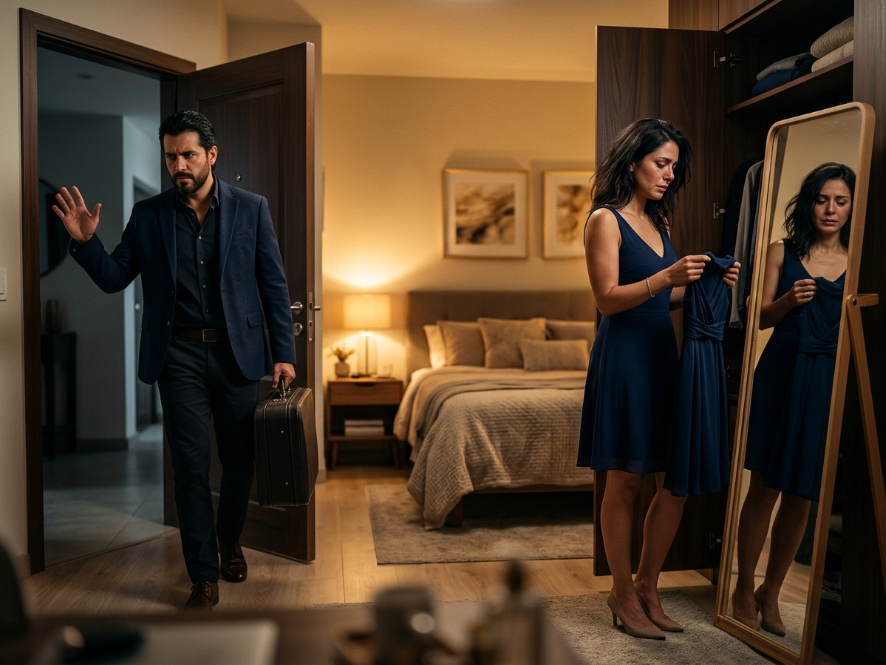
I stood in front of the bedroom mirror, smoothing invisible wrinkles from my emerald dress for the third time.
Behind me, my husband, Richard, adjusted his cufflinks without looking up.
“You can’t seriously be wearing that.”
I turned.
“What’s wrong with it?”
He sighed dramatically, like I’d asked the world’s dumbest question.
“It’s… fine.”
The pause before the word hurt more than the word itself.
“I just don’t think you should come tonight.”
I laughed nervously.
“What?”
“The charity gala.”
“You invited me weeks ago.”
“I know.”
Another sigh.
“The people attending are CEOs, politicians, investors… They’re not exactly your crowd.”
“My crowd?”
“You’ll misunderstand conversations. You’ll feel uncomfortable.”
His eyes finally met mine.
“And honestly…”
He hesitated.
“I don’t want people thinking we’re… uneven.”
The room became painfully quiet.
“What does that mean?”
He rubbed his forehead.
“You work at a community library.”
“I manage three branches.”
“They won’t know that.”
“So?”
“They’ll assume you’re just…”
He searched for a kinder word.
“…ordinary.”
I stared at him.
“I’ve spent fifteen years supporting your career.”
“I know.”
“I hosted dinners.”
“Yes.”
“I raised our daughter while you traveled.”
“I appreciate it.”
“I edited your presentations.”
“You did.”
“And now you’re embarrassed to be seen with me?”
Richard looked annoyed instead of guilty.
“Don’t make this emotional.”
“I’m your wife.”
“I’m protecting both of us.”
“No.”
I swallowed the lump in my throat.
“You’re protecting yourself.”
He picked up his tuxedo jacket.
“If you stay home, no one gets embarrassed.”
The front door closed.
I stood there listening to the silence.
Our daughter, Emma, walked downstairs.
“Didn’t Dad leave?”
“Yes.”
“Aren’t you going?”
I forced a smile.
“Plans changed.”
She looked at my face for one second.
“You fought.”
“No.”
“Mom.”
I sat on the stairs.
“He thinks I’ll ruin his reputation.”
Emma’s expression hardened.
“He actually said that?”
“More or less.”
She grabbed my hand.
“Then he’s the one with the reputation problem.”
I almost changed into pajamas.
Instead, my phone rang.
Unknown number.
“Hello?”
“Mrs. Bennett?”
“Yes.”
“This is Lauren from the Hamilton Foundation.”
“Yes?”
“We’re calling because Mr. Bennett arrived alone.”
“I see.”
“Our chairwoman specifically requested to meet the person responsible for the Riverside Literacy Initiative.”
I blinked.
“…Me?”
“Yes.”
“We were told you created the program.”
“I did.”
“We’ve heard extraordinary things.”
I frowned.
“Richard never mentioned…”
“Oh.”
Silence.
“Would you still be willing to attend? We’d be honored.”
I looked at the dress hanging over the chair.
Ten minutes later, I was driving downtown.
Not because of Richard.
Because for the first time in years…
Someone wanted me there.
The ballroom glittered beneath crystal chandeliers.
Hundreds of guests filled the room.
Richard saw me almost immediately.
His smile disappeared.
He hurried across the floor.
“What are you doing here?”
“I was invited.”
“I specifically asked—”
“I know.”
His jaw tightened.
“You’re making a mistake.”
Before I could answer…
A woman in her sixties approached with warm eyes and silver hair.
“There you are!”
She hugged me.
“I’m Margaret Ellis.”
“The foundation chair?”
“And the biggest admirer of your literacy work.”
Richard froze.
Margaret turned toward him.
“You must be the lucky husband.”
Richard forced a smile.
“Yes.”
Margaret laughed.
“We’ve been trying to meet your wife for months.”
Richard looked confused.
“I’m sorry?”
“Her program increased adult literacy rates by thirty-eight percent.”
He stared at me.
Margaret continued.
“Do you know how rare that is?”
“I…”
“We’ve studied her model.”
Richard looked like someone had removed the floor beneath him.
Margaret slipped her arm through mine.
“Come.”
“The education ministers have been waiting to meet you.”
She led me away.
Richard remained standing alone.
The next hour felt surreal.
People recognized my name.
Not because I was Richard Bennett’s wife.
Because they’d read research papers about the literacy initiative.
A university president shook my hand.
“We’ve adapted your volunteer structure.”
A senator smiled.
“My district uses your community reading model.”
An international nonprofit director said,
“We’ve translated your training materials into six languages.”
I could barely process it.
For years, I’d quietly built something meaningful.
Never expecting recognition.
Never needing it.
But hearing strangers describe lives changed because of our work…
I realized something.
I had spent so long believing Richard’s version of me…
I’d forgotten my own.
During dinner, Margaret stood behind the podium.
She tapped the microphone.
“Ladies and gentlemen.”
“The Hamilton Foundation presents its annual Community Impact Award.”
Polite applause.
“This year’s recipient transformed education without asking for attention.”
My stomach tightened.
“The winner is…”
She smiled directly at me.
“Sophia Bennett.”
The ballroom erupted.
Everyone stood.
Standing ovation.
I remained frozen.
Margaret laughed.
“Sophia.”
“Come save me from this speech.”
Emma would later tell me she cried watching the livestream.
Richard didn’t clap.
Not at first.
Then he noticed everyone watching him.
Slowly…
Reluctantly…
He joined the applause.
I accepted the crystal award with trembling hands.
“I wasn’t expecting this.”
Gentle laughter.
“I’ve spent twenty-two years working in public libraries.”
“I’ve learned something important.”
“People don’t become invisible because they lack value.”
“They become invisible because someone convinces them their value doesn’t matter.”
The room fell silent.
I continued.
“Every person who learns to read gains something impossible to measure.”
“Confidence.”
“Choice.”
“Dignity.”
“My job has never been about books.”
“It’s been about reminding people they deserve another chapter.”
When I finished…
The applause lasted nearly a full minute.
After the ceremony, reporters surrounded me.
Richard waited until they left.
“I didn’t know.”
His voice sounded smaller than I’d ever heard it.
“You never asked.”
“I knew you worked at the library.”
“You knew where I worked.”
“You never cared what I did.”
He opened his mouth.
Closed it again.
“I thought…”
“You thought I was ordinary.”
“I didn’t mean—”
“You did.”
He looked down.
“I’m sorry.”
The apology floated between us.
Late.
Fragile.
Insufficient.
“I’ve spent years shrinking myself.”
“So you could feel taller.”
His eyes filled with regret.
“I was wrong.”
“Yes.”
“You were.”
The following week, my inbox exploded.
Universities invited me to speak.
National organizations requested partnerships.
Publishers asked me to write a book about community education.
One afternoon, Richard walked into my office carrying flowers.
“I made reservations.”
“I thought we could celebrate.”
I smiled politely.
“What exactly?”
“You.”
I looked at him for a long moment.
“For years, I begged you to see me.”
“You only looked once everyone else did.”
His shoulders slumped.
“I know.”
“I can’t change the past.”
“No.”
“You can’t.”
Months passed.
Richard tried.
He attended my speeches.
He volunteered at literacy events.
He listened more than he talked.
People asked whether I forgave him.
Forgiveness, I discovered, wasn’t a single moment.
It was a choice made repeatedly.
Some days, I believed our marriage deserved another chance.
Other days, I remembered the woman folding her dress back into the closet because her husband thought she wasn’t enough.
Healing wasn’t quick.
Respect had to be rebuilt.
Not requested.
Earned.
One year later, I stood before five hundred new volunteers.
Many looked nervous.
Unsure.
Small.
I recognized the feeling.
I smiled.
“The world will always have people who measure your worth by titles, salaries, appearances, or connections.”
I held up the Community Impact Award.
“They’re measuring the wrong things.”
“The people who change lives rarely enter the room believing they’re the most important person there.”
“They become important because they make other people feel seen.”
After the applause ended, a young volunteer approached.
“I almost didn’t come today.”
“Why?”
“I thought someone like me couldn’t make a difference.”
I smiled.
“I used to believe that too.”
As she walked away with renewed confidence, I realized something beautiful.
Richard had once said I would ruin his reputation.
Instead…
The night he tried to hide me became the night I finally stopped hiding myself.
And that was the greatest reputation I would ever build.
Part 2: My Husband Said I’d Ruin His Reputation… Instead, I Became the Most Important Woman in the Room
Three weeks after the gala, my life barely resembled the one I’d been living before.
Every morning, my inbox overflowed with invitations.
School districts wanted advice.
Universities wanted lectures.
Nonprofits wanted partnerships.
Television producers wanted interviews.
The woman who had once quietly organized library reading circles was suddenly being introduced as an expert in community education.
It still felt strange.
I never chased recognition.
I only wanted people to discover that reading could change their lives.
Meanwhile, Richard watched everything unfold from the other side of our kitchen table.
One evening he placed two cups of coffee between us.
“I miss talking to you.”
I looked up from my laptop.
“We’re talking now.”
“No.”
He smiled sadly.
“We’re sharing a room.”
There was a difference.
For years I had begged him to notice me.
Now he was the one asking for my attention.
I closed the laptop.
“What do you want to say?”
He hesitated.
“I’ve been thinking about that night.”
“The gala?”
“Yes.”
“I keep replaying what I said.”
“So do I.”
“I wish I could erase it.”
“You can’t.”
“I know.”
His shoulders slumped.
“I just hope one day you’ll believe that isn’t who I want to be anymore.”
I looked at the man I’d loved for nearly twenty years.
He looked older.
Not because of age.
Because regret leaves its own wrinkles.
“I don’t need another apology, Richard.”
“What do you need?”
“I need consistency.”
Two months later I received an unexpected phone call.
It was Margaret Ellis.
“Sophia, I have a proposal.”
“I’m listening.”
“The Foundation is opening a National Literacy Center.”
My heart skipped.
“We’d like you to direct it.”
I nearly dropped my phone.
“Me?”
“Yes.”
“It would oversee programs across the country.”
“The board voted unanimously.”
“I’ve never managed something that large.”
Margaret laughed.
“Neither had anyone else before their first opportunity.”
“What about interviews?”
“We’ve already interviewed everyone.”
“And still chose you.”
The salary was nearly triple what I earned at the library.
The position included travel, research funding, and a staff of forty people.
Most importantly…
It meant expanding programs that could help millions.
I accepted.
That evening I told Emma first.
She screamed so loudly through the phone I had to hold it away from my ear.
“I knew it!”
“I knew people would finally realize how incredible you are!”
I laughed.
“You sound prouder than I feel.”
“Mom.”
“I’ve always been proud.”
“Dad just took longer.”
Richard came home later that night.
“I have news.”
He smiled.
“So do I.”
“You first.”
“I got promoted to Regional Vice President.”
“Congratulations.”
He waited.
“Aren’t you going to ask what that means?”
“What does it mean?”
“It means a larger office.”
“Better salary.”
“More responsibility.”
I smiled politely.
“That’s wonderful.”
He seemed disappointed by my calm reaction.
“Your turn.”
“I accepted a position today.”
“Oh?”
“I’m becoming Executive Director of the National Literacy Center.”
His smile froze.
“The national one?”
“Yes.”
“The Hamilton Foundation?”
“Yes.”
Silence.
Finally he whispered,
“That’s… enormous.”
“It is.”
For the first time in our marriage…
My promotion was bigger than his.
Neither of us mentioned it.
But both of us noticed.
Richard insisted we celebrate.
He invited friends to dinner.
People I’d known for years.
Executives.
Lawyers.
Business owners.
The same people he once believed would judge me.
As dessert was served, one guest smiled.
“Sophia, Richard says you’ve been busy.”
Richard immediately corrected him.
“Actually…”
He looked at me with surprising confidence.
“She’s being modest.”
“My wife runs the largest literacy initiative in the country.”
Everyone turned toward me.
Questions came from every direction.
“How many communities?”
“What’s your biggest challenge?”
“How do adult students stay motivated?”
Richard sat quietly.
Watching.
Listening.
Not interrupting.
Later, after everyone left, he admitted something.
“I realized something tonight.”
“What?”
“They weren’t impressed because you’re my wife.”
“They were impressed because of what you’ve accomplished.”
I nodded.
“I know.”
“And honestly…”
He smiled.
“So was I.”
Several weeks later I visited my old library.
The building looked exactly the same.
Children filled the reading corner.
Mrs. Alvarez, who had volunteered for fifteen years, hugged me tightly.
“You haven’t forgotten us.”
“Never.”
One little boy ran over carrying a book.
“Miss Sophia!”
“I finished it!”
“You did?”
He nodded proudly.
“All by myself.”
His mother quietly wiped away tears.
“He couldn’t read a single sentence last year.”
I knelt beside him.
“What are you reading next?”
He grinned.
“The big dinosaur one.”
Watching him run toward the shelves…
I remembered why I’d started all of this.
Awards were wonderful.
Recognition felt validating.
But this…
This was the real reward.
That afternoon, an elderly man approached me.
His name was Harold.
I recognized him immediately.
He’d joined one of my first adult literacy classes years earlier.
“I wanted to thank you.”
“You already have.”
“No.”
He shook his head.
“You don’t understand.”
He reached into his jacket pocket.
Carefully unfolding a faded letter.
“I couldn’t read this when my wife died.”
I felt my throat tighten.
“My daughter had to read it aloud.”
He smiled softly.
“After your classes…”
“I finally read it myself.”
“What did it say?”
Tears filled his eyes.
“It said she believed in me.”
He folded the letter again.
“You gave me the chance to hear her voice one last time.”
Neither of us spoke for several moments.
Some victories never appear in newspaper headlines.
But they matter more than any trophy.
One evening Richard asked if I’d accompany him to another corporate gala.
I smiled.
“The same hotel?”
He nodded.
“I understand if you don’t want to.”
I considered it.
Then answered honestly.
“I’ll go.”
His face brightened.
“But on one condition.”
“Anything.”
“If anyone asks who I am…”
“I’ll answer.”
He looked confused.
“What do you mean?”
“I don’t want to be introduced as your wife.”
He nodded slowly.
“How should I introduce you?”
I smiled.
“The truth.”
The ballroom looked almost identical to the previous year.
Only this time…
Everything felt different.
People recognized me before they recognized Richard.
Margaret greeted me.
Government officials waved.
Teachers lined up to say hello.
Then someone approached Richard.
“And who is this lovely lady?”
Without hesitation, he smiled proudly.
“This is Dr. Sophia Bennett.”
“My wife.”
“But more importantly…”
“She’s the woman who’s taught this country that literacy changes lives.”
I looked at him.
Really looked.
There was no embarrassment in his eyes.
No insecurity.
No competition.
Only respect.
Real respect.
For the first time in years…
It wasn’t an act.
It was genuine.
Later that night we stood on the hotel balcony overlooking the city.
Richard broke the silence.
“You know…”
“I spent years believing success meant being the most important person in every room.”
He laughed quietly.
“I was wrong.”
I slipped my hand into his.
“The most important people…”
“They’re usually the ones helping everyone else shine.”
He smiled.
“I finally understand that.”
I squeezed his hand.
“So do I.”
Below us, the city lights stretched toward the horizon.
A year earlier, I would have believed my husband’s opinion defined my worth.
Now I understood something much more powerful.
The people who truly love you never ask you to become smaller so they can feel bigger.
They celebrate your light.
And if they learn that lesson too late…
The choice to let them grow alongside you is yours alone.
End of Part 2
Part 3: My Husband Said I’d Ruin His Reputation… Instead, I Became the Most Important Woman in the Room
Six months after Richard introduced me with genuine pride, I thought the hardest part of our marriage was behind us.
I was wrong.
Because sometimes, the biggest test doesn’t come from strangers.
It comes from family.
One Saturday morning, Richard’s mother, Evelyn, invited us to lunch.
She rarely called.
And when she did, there was usually a reason.
The dining room smelled of fresh bread and roasted chicken.
His younger brother, Daniel, and Daniel’s wife, Melissa, were already there.
Everyone congratulated me on the National Literacy Center.
Everyone except Evelyn.
She smiled politely.
“So, Sophia.”
“I hear you’re quite famous now.”
I laughed.
“I wouldn’t say famous.”
“Television interviews.”
“Magazine covers.”
“Government meetings.”
She sipped her tea.
“That’s more attention than a librarian usually gets.”
The table fell quiet.
Richard glanced at me.
I ignored the comment.
“It’s really about the programs.”
“Not me.”
Evelyn smiled again.
“I’m sure.”
Lunch continued awkwardly.
Then Daniel mentioned something unexpected.
“Mom wants to sell Grandpa’s farm.”
Richard looked surprised.
“I thought Grandpa wanted it kept in the family.”
“He did.”
Daniel sighed.
“But repairs will cost nearly $400,000.”
Everyone looked toward Evelyn.
“I’ve already spoken with a developer.”
She nodded.
“They’re offering a good price.”
My heart sank.
Richard’s grandfather had built that farm after returning from the war.
Every family gathering had been held there.
Every birthday.
Every Christmas.
Every summer.
“You’ve already decided?”
Richard asked.
“I have.”
Daniel frowned.
“I thought we’d vote.”
“There isn’t anything to discuss.”
Evelyn answered firmly.
“It’s business.”
That evening, Richard couldn’t sleep.
He stood on our back porch staring into the darkness.
“I learned to ride a bike there.”
He whispered.
“My grandfather planted every tree himself.”
I wrapped a blanket around his shoulders.
“You don’t want to lose it.”
“No.”
“But I can’t afford to save it.”
Neither could Daniel.
The property taxes alone were enormous.
The family had no realistic solution.
Or so they believed.
The following Monday I asked Margaret for advice.
She listened carefully.
Then smiled.
“Tell me something.”
“Does the farm have historical value?”
“Yes.”
“Educational value?”
“It was one of the first integrated farming cooperatives in the county.”
Margaret leaned forward.
“And no one mentioned that?”
“I don’t think anyone even knows.”
She picked up the phone.
“I know someone you should meet.”
A week later I walked through the old farmhouse with two representatives from a heritage preservation foundation.
They inspected the barns.
The orchards.
The original schoolhouse Richard’s grandfather had built for migrant workers’ children.
One woman stopped suddenly.
“This is remarkable.”
“What?”
“The school records.”
She carefully held up a weathered attendance book.
“These document one of the earliest literacy programs in rural communities.”
I froze.
“What did you say?”
She smiled.
“Sophia…”
“This place isn’t just a farm.”
“It’s history.”
Three weeks later, the foundation made an offer.
Not to buy the land.
To preserve it.
They would provide restoration grants.
Educational funding.
Historic protection.
The family could keep ownership while turning the property into a living education center.
Richard stared at the proposal.
“This can’t be real.”
“It is.”
Daniel looked at me.
“You found this?”
“I just asked questions.”
Evelyn remained silent.
For a very long time.
Finally she whispered,
“I never knew.”
The vote happened the following Sunday.
Instead of selling…
The family unanimously agreed to preserve the farm.
Richard hugged his brother.
Daniel cried openly.
Even Evelyn looked emotional.
As everyone celebrated, she quietly approached me.
“I owe you an apology.”
I smiled gently.
“You don’t have to.”
“Yes.”
“I do.”
She looked toward the old barn.
“For years…”
“I believed Richard married beneath himself.”
Those words hurt.
But they weren’t surprising.
“I thought ambition only existed in boardrooms.”
She swallowed hard.
“I was terribly wrong.”
I simply listened.
“You didn’t save our property.”
She said.
“You saved our family’s story.”
The farm reopened a year later.
School buses arrived almost every day.
Children learned about farming, history, and literacy.
Retired teachers volunteered.
College students conducted research.
Former farmworkers shared their memories.
One classroom displayed photographs of Richard’s grandfather teaching adults to read beneath a giant oak tree.
The same mission.
Different generation.
Margaret attended the opening ceremony.
“So…”
She smiled.
“You’ve accidentally created another education project.”
I laughed.
“It keeps happening.”
That afternoon, a television reporter interviewed me.
“What motivates you?”
I thought for a moment.
Then answered honestly.
“When people feel unseen…”
“They stop believing they matter.”
“My job isn’t to give people importance.”
“It’s to remind them they already have it.”
The interview aired nationwide.
I forgot about it.
Until my phone started ringing.
The first call came from an old coworker.
“The governor wants to visit the farm.”
The second came from a university.
“They’d like to establish a research partnership.”
The third came from a publisher.
“They’re increasing the first printing of your book.”
By evening, social media was flooded with clips from the interview.
One sentence kept appearing everywhere.
‘People don’t need someone to make them valuable. They need someone to notice the value already there.’
I smiled.
It wasn’t planned.
It was simply true.
A month later, Emma came home for the weekend.
She walked into the kitchen carrying a small envelope.
“I have something.”
“What is it?”
She handed it to me.
Inside was a photograph.
Me.
Standing beside a bookshelf twenty years earlier.
Surrounded by six children during my very first reading program.
On the back, someone had written:
“The lady who taught me my first book.”
Emma smiled.
“I found it online.”
“One of those kids posted it.”
I turned the photo over again.
The handwriting belonged to a little boy named Marcus.
I remembered him.
He struggled to read even simple sentences.
“What happened to him?”
Emma grinned.
“You should read the caption.”
She handed me her phone.
“Today I graduated from medical school.”
“None of this would’ve happened without Miss Sophia believing I could read.”
My eyes filled with tears.
Of every award.
Every interview.
Every standing ovation.
Nothing compared to that one sentence.
That evening, Richard found me sitting on the porch holding the photograph.
He sat beside me.
“What’s that?”
I handed it to him.
He read the caption twice.
Then looked at me.
“I spent years chasing promotions.”
He said quietly.
“You spent years changing lives.”
Neither of us spoke for several moments.
Finally he whispered,
“I don’t think I’ve ever admired anyone more.”
This time…
I believed him.
As autumn arrived, the restored farm hosted its largest community festival.
Thousands of visitors filled the fields.
Children read stories beneath the old oak tree.
Families explored the museum.
Former students volunteered as mentors.
Just before sunset, the mayor stepped onto the stage.
“We have one final announcement.”
The crowd became quiet.
“In recognition of decades of service to education…”
He smiled toward me.
“We’re dedicating this new community learning center.”
A curtain fell away.
Revealing a simple wooden sign.
The Sophia Bennett Learning House
I covered my mouth.
“No…”
Richard squeezed my hand.
“You deserve this.”
The crowd applauded.
But all I could think about was the young woman who had once folded an emerald dress back into her closet because she believed she wasn’t worthy of being seen.
If only she could have looked into the future.
She would have discovered that the opinions meant to diminish her were never the final chapter.
They were only the beginning of her story.
End of Part 3